

In a significant legislative development, President Droupadi Murmu has granted her assent to the Waqf (Amendment) Act, 2025, following its passage in both houses of Parliament earlier this week. The Rajya Sabha approved the bill with 128 votes in favor and 95 against after nearly 17 hours of deliberation, while the Lok Sabha had passed it earlier following a 13-hour debate.
Prime Minister Narendra Modi hailed the enactment as a “watershed moment,” emphasizing that the waqf system had long been plagued by a lack of transparency and accountability. He stated, “This legislation will boost transparency and safeguard people’s rights,” he posted on X.
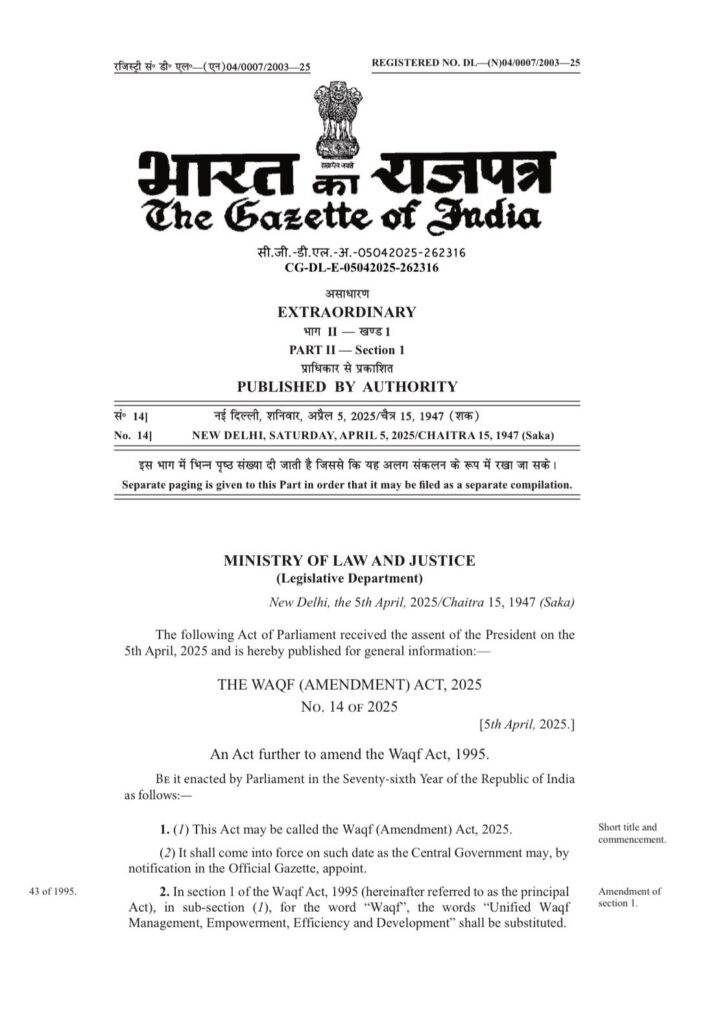
The Act aims to reform the governance of waqf properties by enhancing transparency in their management and ensuring representation from various Muslim sects in waqf boards. It includes provisions to safeguard heritage sites, improve social welfare, and support the economic inclusion of marginalized groups, particularly Muslim widows and divorcees.
Minority Affairs Minister Kiren Rijiju, who introduced the bill, asserted that it would benefit millions of poor Muslims and does not interfere with waqf properties. He criticized the opposition for attempting to mislead the Muslim community, stating, “Not a single Muslim is going to be harmed. Crores of poor Muslims are going to benefit by passing the historic Waqf Amendment Bill.”
However, the legislation has faced opposition. Congress MP Mohammad Jawed and AIMIM president Asaduddin Owaisi have challenged its validity in the Supreme Court, arguing that it imposes arbitrary restrictions on waqf properties and undermines the religious autonomy of the Muslim community. Owaisi’s plea contends that the law is “manifestly arbitrary, perpetuates discrimination on grounds of religion, violates the Shariat Act, and strips the Muslim community of the right to manage its own religious institutions.”